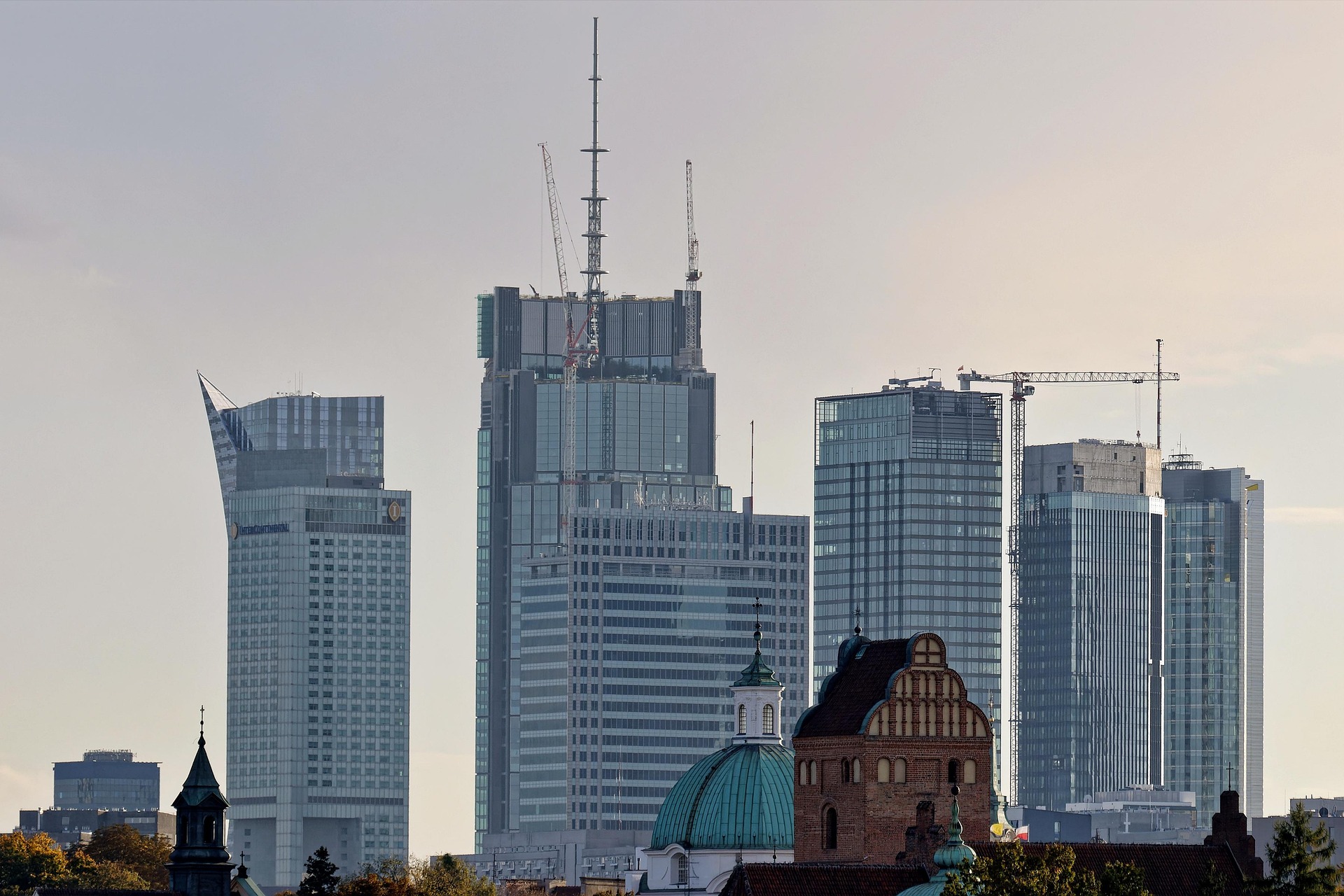
For data centre investors, cooling is no longer a back-of-house engineering detail. It is the single biggest swing factor in operating cost, carbon footprint and asset value. Cooling can account for up to 40% of a facility’s energy use, which means the climate a building sits in is now a balance-sheet item. This is precisely where Central & Eastern Europe (CEE) is rewriting the European map: a naturally cool climate converts “sustainable cooling” from an ESG slogan into a hard return on invested capital.
Why cool-climate geography is an investable advantage
Free cooling using cold outside air or water instead of mechanical compressors, eliminates the most energy-hungry part of a data centre whenever ambient temperatures are low enough. In suitable northern climates this can cut cooling energy by roughly 70% and cover 60–80% of the hours in a year without conventional chillers. Poland sits squarely in this sweet spot: according to the Polish Investment & Trade Agency (PAIH), the country has some of the lowest annual ambient temperatures in Europe outside the Nordics, allowing operators to design for maximum free-cooling hours from day one.
For a real-estate owner, that geography translates into a structurally lower PUE (Power Usage Effectiveness). Leading Polish campuses such as Data4’s Jawczyce site already operate around a PUE of 1.27 and target sub-1.3 on 100% low-carbon energy. Figures that protect net operating income against rising power prices and tightening efficiency regulation across the EU.
Waste heat: turning a cost centre into a revenue line
Cool-climate CEE has a second, less obvious advantage: dense district-heating networks that can buy a data centre’s waste heat. Poland operates the second-largest district-heating network in Europe, and the decarbonisation of legacy coal-fired combined heat-and-power plants is freeing up well-connected sites with both high-voltage grid access and ready heat off-take. Under the EU Energy Efficiency Directive (2023/1791), facilities above 1 MW must now assess heat-recovery feasibility turning a compliance obligation into an income opportunity.
The economics are real: heat off-take can add an estimated 3–8% to EBITDA for well-sited facilities, with contracts typically paying €3–9 per MWh of exported heat plus avoided dry-cooler and chiller costs. Nordic precedents show the scale in Finland, Fortum expects data-centre waste heat to supply up to about 65% of a local district-heating network once new campuses ramp up. CEE’s heating-grid density makes it the natural next region to capture this value.
Capital is already moving
The investment signal is unambiguous. Poland is the fastest-growing national data-centre cooling market in Europe, expanding at roughly 16% CAGR. The wider market was valued at about USD 2.36 billion in 2024 and is projected to reach USD 5.41 billion by 2035, with installed capacity set to climb from below 200 MW today toward 500 MW-plus by 2030. Warsaw anchors the region with around 28 colocation sites, roughly one-third of national capacity, acting as a workload gateway between Western and Eastern Europe.
Hyperscalers are underwriting that thesis with hard commitments: Microsoft announced a PLN 2.8 billion investment in early 2025, Google has committed over USD 2 billion, and Vantage is planning a 64 MW campus. For real-estate investors this de-risks land and shell development, supports stabilised leasing values per megawatt, and signals durable tenant demand.
What investors should watch
- Grid connection is the binding constraint, not climate. Polish transmission operator PSE faces application backlogs, so secured high-voltage capacity is the scarcest, most value-accretive asset attribute.
- Sites adjacent to district-heating infrastructure command an additional revenue option and stronger ESG positioning prioritise locations with heat off-take potential.
- AI workloads push rack densities to 40–80 kW, requiring liquid cooling; cool-climate free cooling pairs with liquid loops to keep PUE low even at high density.
- EU efficiency rules (e.g. PUE caps and renewable mandates) reward cool-climate assets and penalise legacy hot-climate stock a regulatory tailwind for CEE.
The takeaway for the Prime East investor base: in a power-constrained, decarbonising Europe, the cool climate of CEE is not a soft amenity. It is a measurable, compounding cost and revenue advantage. Sustainable cooling here is where real-estate fundamentals and the energy transition finally align.
Sources
1. PAIH – Poland: A Cool Place for Data Centre Development (2025) https://www.paih.gov.pl/wp-content/uploads/2026/01/Poland-A-cool-place-for-data-centre-development-2025.pdf
2. Mordor Intelligence – Europe Data Center Cooling Market https://www.mordorintelligence.com/industry-reports/europe-data-center-cooling-market-industry
3. Build.inc – Data Center Cooling in 2026 https://build.inc/insights/data-center-cooling-technology-2026
4. ScienceDirect – Data center waste heat for district heating networks (2025) https://www.sciencedirect.com/science/article/pii/S1364032125005362
5. DatacenterDynamics – atNorth DEN01 waste heat, Copenhagen https://www.datacenterdynamics.com/en/news/atnorth-to-supply-waste-heat-from-den01-data-center-to-district-heating-network-in-copenhagen-denmark/
6. Cushman & Wakefield – EMEA Data Centre Update H2 2025 https://www.cushmanwakefield.com/en/insights/emea-data-centre-update
7. Energy Solutions – Data Center Waste Heat 2026 https://energy-solutions.co/articles/sub/data-center-waste-heat-district-heating
8. Baker McKenzie – Data Centers in Poland Attract Investor Interest (2025) https://www.bakermckenzie.com/en/newsroom/2025/07/data-centers-in-poland-attract-investor-interest