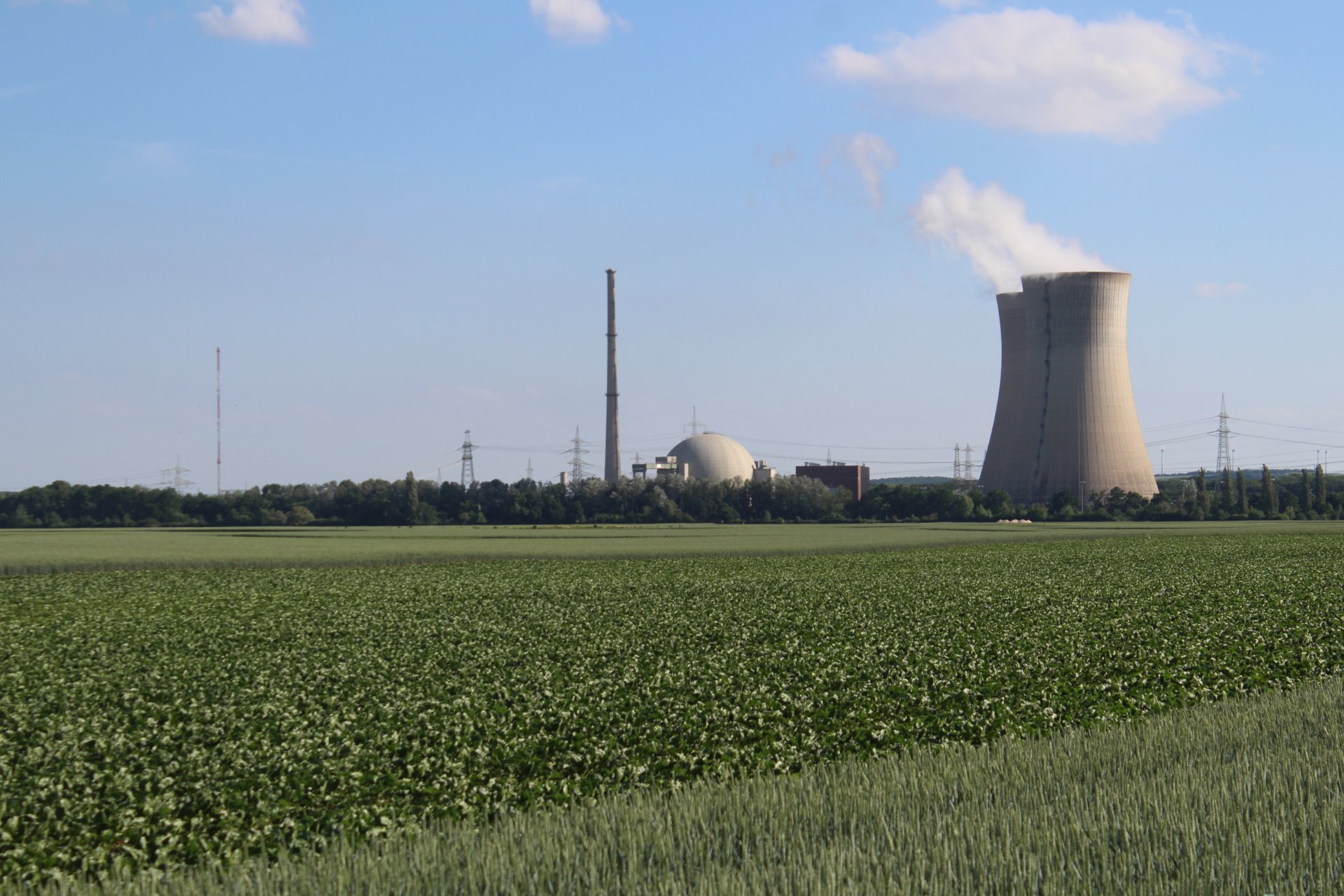
Germany’s transmission operators received connection requests for 147 GW in the first half of 2026, and the economy ministry now wants to reserve grid access for data centres and industry by law. In the same week, PreussenElektra and Nvidia began assessing former nuclear sites for AI factories, while PGE and NASK in Poland offered power plant land with grid, fibre and heat exchangers already in place. The scarcest data centre land in both countries is where electricity used to be made.
147 GW in the queue and a ministry that wants to choose
According to Clean Energy Wire, citing a Tagesspiegel Background report from ministry sources, Germany’s four transmission system operators received 346 connection requests covering 147 GW in the first half of 2026. In the 50Hertz area alone, 141 of 179 requests came from battery storage projects, together 70 GW. The Federal Ministry for Economic Affairs and Energy now intends to secure transmission grid access for data centres and industrial users by law, after the operators asked in early October for clear political rules on who gets connected first. The IEA puts connection lead times at up to seven years; Cologne utility RheinEnergie speaks of 10 to 15. The maturity-based allocation introduced in April, which we analysed in First Ready, First Served, sorts the queue but does not shorten it.
JLL’s EMEA mid-year report shows what scarcity does to prices. Frankfurt’s colocation vacancy stood at 3.1 per cent in the second quarter, with 311 MW under construction and 687 MW planned. Prime powered land in the core markets costs 2.26 million euros per MW, up 82 per cent since 2021, and primary markets trade at 2.3 times the price of secondary locations. Hyperscale sites in the pipeline now sit on average 175 km from a hub city, up from 46 km. Capacity is moving to wherever a connection already exists.
Germany: eight reactors, ten RWE sites and a 380 kV node at Staudinger
On 21 October, PreussenElektra, the E.ON subsidiary dismantling eight German nuclear plants, announced a joint study with Nvidia on whether its former sites suit AI factories. The partners will compare existing energy and site infrastructure and available land with the requirements of AI data centres. The company calls the study open-ended, with no investment or siting decisions attached. Two days later, NWZ reported that the Unterweser plant at Kleinensiel is among the sites to be examined; its nuclear dismantling is expected to finish in 2032, followed by two to three years of conventional demolition.
EnBW is further along at Neckarwestheim. The municipality opened the zoning procedure in March 2026 for a data centre next to the shut-down plant, with a planning area of about 3.94 hectares and a building footprint of up to 2.5 hectares. EnBW’s project page gives a building permit application from the third quarter of 2027, construction from the third quarter of 2028 and commissioning around the fourth quarter of 2030. The site reuses power infrastructure freed by the plant’s closure and existing redundant fibre; the grid connection itself is decided separately by the responsible operator. No MW figure has been published.
Uniper has identified more than ten of its own plant sites with suitable infrastructure, three projects are in advanced development and further investment decisions are expected before the end of 2026, dpa reported in August. Chief executive Michael Lewis put it plainly: developers in Germany often wait years for a connection commitment, while Uniper already has connections at many sites. At Staudinger east of Frankfurt, TenneT has agreed to build a new central grid node with 380 kV switchgear expected by 2030. RWE told analysts in August that around ten data centre sites are in development and that an agreement is close for two plots. The same sites attract the other large bidder for capacity: PreussenElektra plans a battery of up to 800 MW and 1,600 MWh at Brokdorf, Energie & Management reported. On a former plant site, a data centre competes with storage for the same switchgear.
Poland: PGE’s land, NASK’s servers and 500 MW next to Bełchatów
In mid-October, at the European Forum of New Ideas in Sopot, state-controlled utility PGE and the national research institute NASK announced a programme to build data centres on PGE land. According to Rzeczpospolita, PGE brings industrialised sites with grid connections, fibre and heat exchangers, and claims that reusing this infrastructure and dropping part of the cooling plant cuts investment costs by 30 per cent. Warm water from the servers is to feed PGE’s district heating networks; a data centre of about 50 MW could heat a town of up to 15,000 residents, the partners say. The digital affairs and state assets ministries back the scheme as a matter of digital sovereignty.
The anchor site is already on the map. Bełchatów municipality confirmed in February that it is in advanced talks with an unnamed investor about a hyperscale campus of up to 500 MW connection capacity on roughly 50 hectares at Domiechowice, close to the Rogowiec substation that serves Poland’s largest coal plant, ITwiz and DCD reported. Konin, at the centre of Wielkopolska’s lignite basin, is moving faster: Energa Obrót, the City of Konin and Centralna Grupa Energetyczna signed a letter of intent on 4 September for the power supply of a data centre worth close to 3 billion euros. Inżynier Budownictwa reports up to 100 MW of IT capacity, an environmental decision from January 2026, a building permit for the first stage from May 2026 and a construction start planned for the first quarter of 2027.
The scale matters. CBRE’s second-quarter report, cited by Eurobuild, puts Poland’s data centre capacity at about 200 MW today and expects 500 MW by 2030. Konin alone would add half of today’s national stock. At Eurobuild’s data centre conference on 19 October, JLL’s Rafał Skowroński summarised the market in one sentence: access to electricity, not its price, now decides where data centres are built.
What a power plant site is worth, and what it is not
The asset is the connection, not the turbine hall. EnBW’s own project page notes that grid matters are decided by the grid operator; a closed generator’s capacity does not transfer automatically to a new load. The due diligence question is whether, when and for how many megawatts the operator will confirm a connection, and the answer is site-specific. Legacy timelines apply too: Neckarwestheim targets 2030, four years after the zoning procedure opened and with land and fibre in hand, while Unterweser’s dismantling runs to 2032. Both beat the seven to ten years quoted for a new connection in the core hubs, but neither is a 2027 story.
Acceptance has become a design parameter. Hillwood Polska reduced the buildings of its 130 MW campus at Reguły near Warsaw and moved them further from homes after residents criticised water use, electricity demand and noise, DCD reported on 19 October. EnBW publishes a night-time noise contribution of 29 dB at full load and offsets forest loss with 3.2 hectares of new woodland. These are the costs of a social licence, and they belong in the budget. For the wider map of where German capacity is moving, see our analysis of the pipeline heading east to Brandenburg.
What this means for investors
- The grid connection is the land value. With 147 GW requested in six months and prime powered land at 2.26 million euros per MW, a confirmed connection at a former plant site is worth more than the site itself. Price the megawatts, not the hectares.
- Utilities have become the landlords. PreussenElektra, EnBW, Uniper, RWE and PGE control the sites with existing switchgear. The realistic entry is a partnership, a lease or a long-term supply structure, not a greenfield purchase.
- Batteries bid for the same capacity. 70 GW of storage requests at 50Hertz and an 800 MW battery planned at Brokdorf show that a data centre is not the only use a utility can put on a connection. Any offer must beat the storage case.
- Timelines are 2030, not 2027. Neckarwestheim and Unterweser point to the end of the decade. Capital with a shorter horizon belongs in projects that already hold a permit, such as Konin.
- Poland prices the state in. The PGE and NASK programme and Energa’s role at Konin put state-controlled utilities at the centre of Polish projects. That lowers connection risk and raises counterparty and governance questions that belong in the term sheet.
This intersection of real estate, engineering and energy is exactly where Prime East operates through its dedicated division PE Property Solutions: site and grid connection assessment, technical due diligence, structuring of operator and lease models, and transaction support across Germany and Poland.
Conclusion
Germany and Poland are arriving at the same answer from opposite directions. Germany is dismantling reactors and discovering that their switchgear is the scarcest asset of the energy transition; Poland is planning its exit from coal and finding that Bełchatów and Konin already have what Warsaw lacks. In both countries, the next gigawatt of data centre capacity will be planned where the last gigawatt of generation was built. For investors, that makes a utility’s real estate portfolio the most interesting land register in the market, provided the connection is confirmed in writing.
Talk to us
Are you evaluating a data centre project on a former power plant or industrial site in Germany or Poland, or do you hold land with an existing high-voltage connection? Prime East assesses sites, connection status and operator models, and brings investors, utilities and landowners together. Contact our team for a confidential discussion of your investment or project enquiry.
Disclaimer: This article is for general information only and does not constitute investment, legal or tax advice. All figures are based on publicly available sources.
Sources
- Clean Energy Wire: Germany to secure transmission grid connections for data centres and industry (23 October 2026)
- PreussenElektra / mainfranken.news: PreussenElektra und NVIDIA prüfen Potenzial ehemaliger Kernkraftwerksstandorte für KI-Fabriken (21 October 2026)
- NWZonline: KI-Fabrik statt Kernkraftwerk: Nvidia und Preussenelektra prüfen auch Standort in Kleinensiel (23 October 2026)
- EnBW: Rechenzentrum Neckarwestheim (project page)
- t-online / dpa: Uniper will Rechenzentren an Kraftwerksstandorten ansiedeln (11 August 2026)
- Münster Aktuell: Uniper setzt bei Rechenzentren auf seine Kraftwerksstandorte (6 September 2026)
- IT Boltwise: RWE erhöht Nettoinvestitionen und setzt auf Rechenzentren sowie Gaskraftwerke (13 August 2026)
- Energie & Management: Künstliche Intelligenz löst Kernkraft ab (26 May 2025)
- JLL: EMEA data centre mid-year 2026 report (3 August 2026)
- Eurobuild CEE / CBRE: AI and cloud demand drives growth in European data centre market (2 October 2026)
- Eurobuild CEE: Power, Power, Power (19 October 2026)
- Rzeczpospolita: Ciepło za infrastrukturę. PGE i NASK we wspólnym projekcie (16 October 2026)
- Dzień Dobry Bełchatów: Gigantyczne obiekty ogrzeją całe miasto? PGE i NASK szykują rewolucyjne rozwiązanie (19 October 2026)
- ITwiz: Bełchatów z szansą na jedno z największych centrów danych w Europie (27 February 2026)
- DCD: 500MW data center campus planned for Bełchatów, Poland (26 February 2026)
- Energa: Chcemy napędzać AI w Polsce. List intencyjny w sprawie zasilania Data Center Konin (4 September 2026)
- Inżynier Budownictwa: W Koninie powstanie największe w Polsce centrum danych dla sztucznej inteligencji (15 September 2026)
- DCD: Hillwood Polska changes data center design in Poland in response to local opposition (19 October 2026)