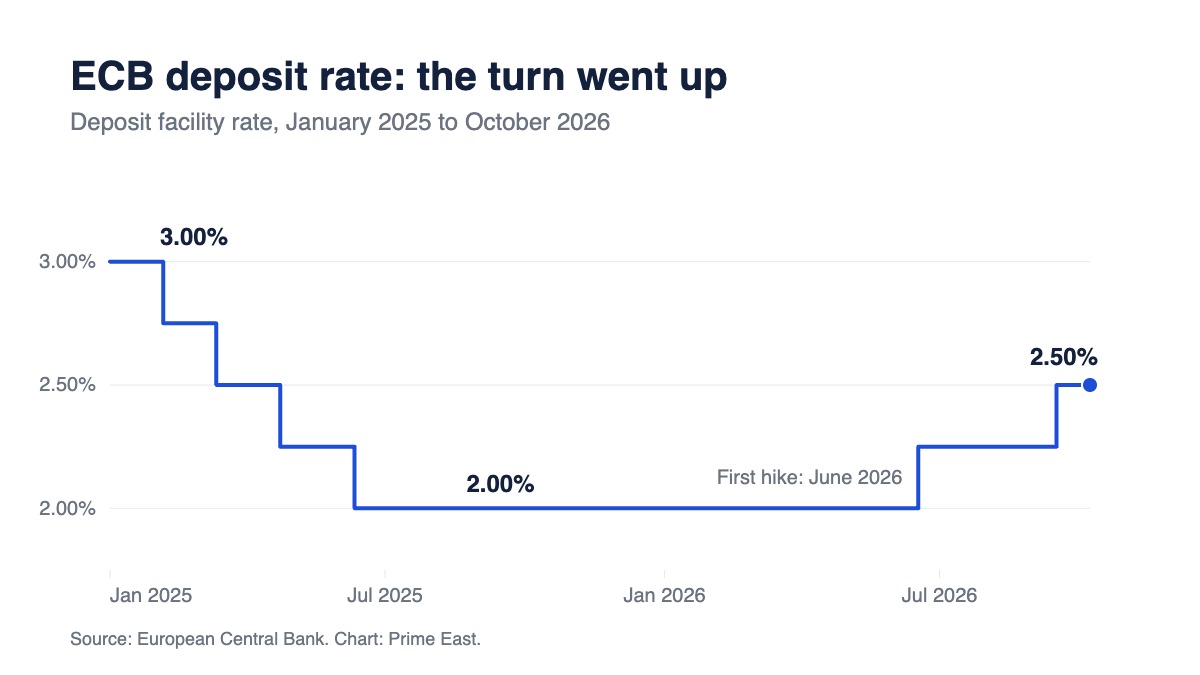
For two years the property market waited for a turn in interest rates. It arrived in 2026, in the opposite direction. With the ECB deposit rate at 2.50% and the ten-year Bund above 3.5%, German property yields are being repriced for the second time in four years.
The turn nobody had priced in
The European Central Bank cut its deposit rate to 2.00% by June 2025 and held it there for a full year. On 11 June 2026 it raised rates by 25 basis points, and on 10 September it followed with another 25. Since 16 September the deposit facility rate has stood at 2.50%, the main refinancing rate at 2.65%.
The Governing Council justified the step with persistent inflation pressure from the Middle East conflict. The data support that reading: Eurostat’s flash estimate puts euro area inflation at 3.8% in September, up from 3.2% in August. Energy prices rose 18.8% year on year, while inflation excluding energy, food, alcohol and tobacco stood at 2.5%. For Germany, Eurostat reports 3.3%.
The ECB’s September projections see inflation at 3.0% in 2026, 2.5% in 2027 and 2.1% in 2028. The bank describes its approach as data-dependent and meeting-by-meeting, without committing to a rate path. The next decision is due on 29 October. LBBW expects two more hikes by the end of the first quarter of 2027, which would take the deposit rate to 3.00%.
The long end moved first
For property, the capital market matters more than the policy rate. The ten-year Bund yield reached 3.69% on 28 September, its highest level since April 2011, and stood at 3.55% on 7 October. At the end of July it had closed above 3% for the first time in this cycle.
Mortgage rates are following. According to Baufi24, the average rate for a ten-year fixed loan was 4.16% in September. Offers in early October were around 4.5% for ten years, and twenty-year fixes are approaching 5%.
What the nine-month figures show
The major brokerages published their third-quarter numbers this week. Depending on the source, the German investment market reached between €21.4 billion (Savills) and €23.9 billion (JLL) in the first nine months of 2026. Year on year, that ranges from minus 9% (Colliers) to plus 8% (Cushman & Wakefield). The more telling detail is the trend: at mid-year, JLL and Cushman & Wakefield still reported gains of 15% and 20%. The summer erased most of that lead.
Activity has not stopped. BNP Paribas Real Estate counts more than 1,040 deals, the highest number since 2022, and Savills reports 4% more transactions on a slightly lower volume. The market is trading in smaller tickets. International capital remains present: according to CBRE, foreign buyers account for around half of the volume, having invested €11.6 billion, 11% more than a year earlier.
Yields have started to move. JLL puts prime office yields in the seven largest cities at 4.59% and prime logistics at 4.69%, each 13 basis points higher than in the previous quarter. Savills reports 3.7% for multi-family housing, up 10 basis points, and 6.0% for shopping centres. Colliers notes that prices for assets already in a sale process are being recalculated. Neither JLL nor BNP Paribas Real Estate expects a year-end rally, and Colliers sees a broader recovery only in the course of 2027.
The arithmetic of the risk premium
Set the numbers side by side. A prime office at 4.59% offers roughly 100 basis points over a ten-year Bund at 3.55%. Prime multi-family housing at 3.7% offers about 15. JLL’s Germany CEO Konstantin Kortmann calls the risk premium clearly too low for most investors.
Financing sharpens the point. With ten-year money at around 4.5%, a residential asset bought at 3.7% costs more to finance than it yields on day one. Leverage reduces the cash return instead of lifting it. Such a purchase only works with a high equity share and credible rental growth. Where neither is available, the adjustment has to come through the price.
Poland: on hold, but no longer easing
The picture east of the Oder is similar in direction, different in level. The Monetary Policy Council left the NBP reference rate at 3.75% on 7 October; its last move was a cut in March. Since then inflation has turned: the flash estimate for September shows 4.0% after 3.4% in August, outside the central bank’s target band of 2.5% plus or minus one percentage point for the first time since June 2025. According to Parkiet, futures markets price rates about 100 basis points higher within a year. The easing cycle is over in both markets.
What this means for investors
- Underwrite at today’s rates. Business plans built on falling rates need a second run. A sensible stress case is a deposit rate of 3.00% and a ten-year Bund that stays above 3.5%.
- Watch refinancing dates. Loans agreed in the low-rate years are rolling into a visibly more expensive market. Savills already sees more product coming to market and little reason for owners to wait.
- Equity is the advantage. Buyers who depend less on debt can act while leveraged bidders recalculate. The rising number of smaller deals reflects this.
- Buy income growth, not yield compression. Indexed leases, reletting potential and manageable capex carry returns when yields are not falling.
- Negotiate with the new benchmark. Sellers who adjust to the rate environment find buyers. Price expectations from spring 2026 do not.
Conclusion
The rate turn the market was waiting for has happened, with the opposite sign. This is not a repeat of 2022: the moves are smaller, and prices had already corrected. But the direction of travel for yields has changed, and the nine-month figures show how quickly momentum faded once the Bund crossed 3%. The coming quarters will reward investors who calculate with the rates on the screen rather than the ones they had hoped for.
Talk to us
Are you reassessing a portfolio, preparing a sale or looking for entry opportunities in Germany or Poland? Prime East analyses assets, financing scenarios and exit routes, and brings investors, owners and developers together. Contact our team for a confidential discussion of your investment or project enquiry.
Disclaimer: This article is for general information only and does not constitute investment, legal or tax advice. All figures are based on publicly available sources.
Sources
- European Central Bank: Monetary policy decisions, 10 September 2026
- European Central Bank: Key ECB interest rates
- Eurostat: Euro area annual inflation up to 3.8%, flash estimate September 2026
- LBBW: ECB rate decision, key rate, forecasts and dates 2026
- Kagels Trading: Interest rate development and forecast 2026, Bund yields
- Baufi24: Interest rate commentary October 2026
- Savills: German real estate investment market Q3 2026
- immobilienmanager: Rising rates slow the recovery on the investment market
- Parkiet: The Monetary Policy Council’s October rate decision