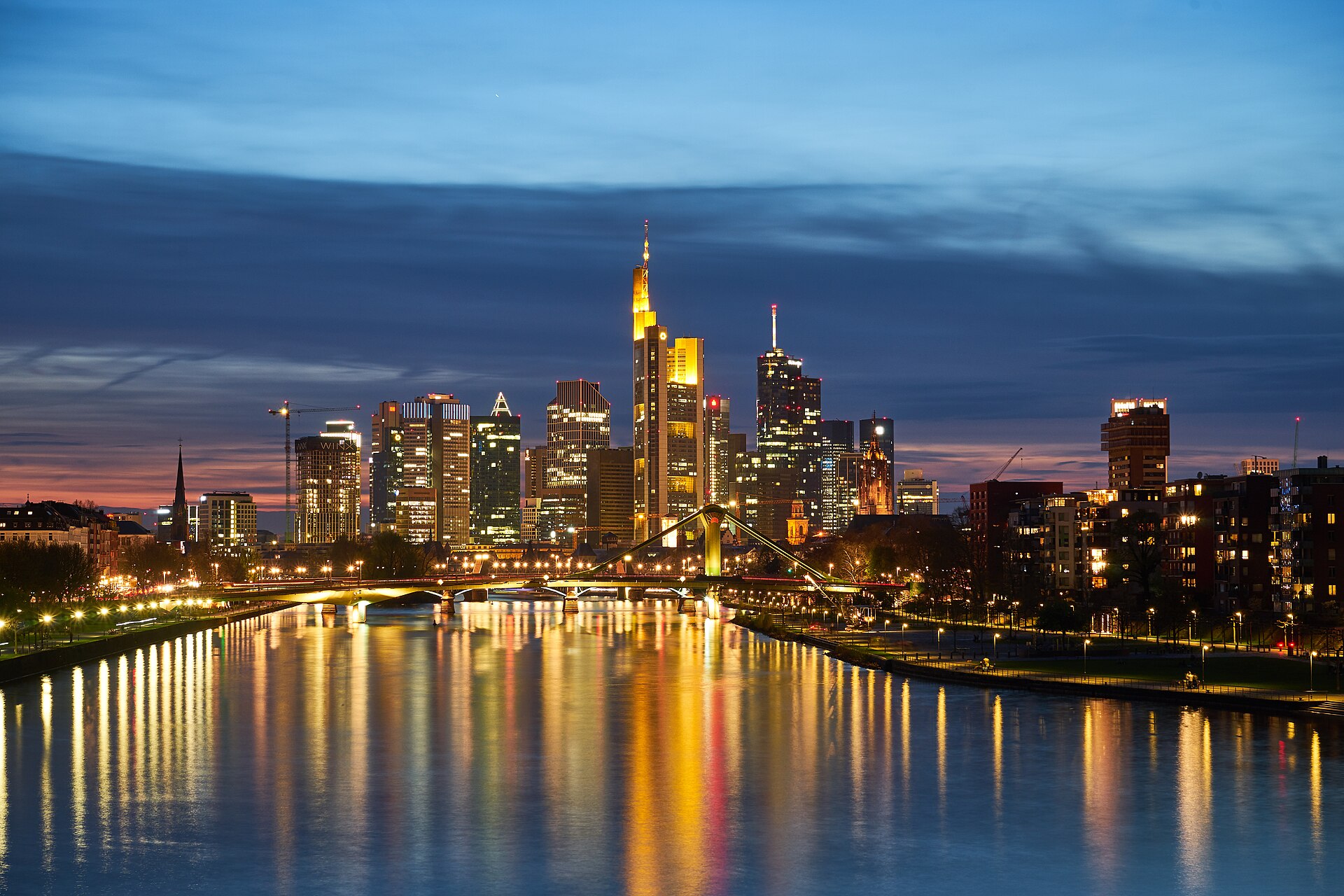
Germany’s seven largest office markets let 2.07 million sq m in the first nine months of 2026, back at last year’s level. At the same time vacancy has climbed to 9 million sq m and prime rents in Munich and Frankfurt have never been higher. The German office market is no longer one market but two.
Take-up is back at last year’s level, but only two cities carry it
According to JLL, office take-up in the Big 7 reached 2.07 million sq m between January and September 2026, 1.3% more than a year earlier. After a weak start to the year, the second and third quarters were both above the prior year, and JLL now expects around 2.76 million sq m for the full year. Savills, which tracks the top six markets, counts 1.9 million sq m and describes the result as flat.
The headline figure hides a split. Berlin let 571,800 sq m, 61% more than in the first nine months of 2025, and Munich 488,400 sq m, up 17.5%. Together the two cities account for more than half of national take-up. The other five markets are around 21% below the prior year: Frankfurt minus 34%, Cologne minus 39%, Hamburg and Stuttgart each around minus 16%. CBRE puts Berlin at 567,400 sq m and the strongest nine-month result since 2022, driven by large deals such as BVG’s lease in the re:o development and owner-occupier projects by JetBrains and BSR.
Frankfurt shows how uneven the recovery is. CBRE records 267,700 sq m for the first three quarters, about 40% below an exceptionally strong prior year, but the third quarter was the best of 2026 with BaFin (around 22,700 sq m in the RAW new build), ODDO BHF (around 14,000 sq m in the Skyper) and AirPlus. The local broker blackolive counts around 129,000 sq m for the quarter alone, more than in the third quarter of 2025. Lease renewals of around 153,000 sq m year to date point in the same direction: many occupiers are staying put rather than moving.
Nine million square metres: vacancy at a fifteen-year high
Vacancy in the Big 7 rose by around 560,000 sq m in the third quarter alone and now stands at 9.0 million sq m, a vacancy rate of 9.0% according to JLL. A year ago the rate was 7.9%, at mid-year 8.5%. Savills reports 9.1% for the top six markets, the first reading above 9% since 2011 and, at around 8.1 million sq m, the highest stock of empty offices since German reunification.
Frankfurt (12.1%) and Düsseldorf (12.0%) lead the table, Cologne is the exception at 5.1%. Munich has passed 2 million sq m of vacant space for the first time, and Berlin’s rate jumped by 0.7 percentage points in a single quarter to 9.3%. Sublet space of 844,800 sq m is slightly below last year, so the increase is coming from leases that end rather than from tenants marketing surplus space. The occupied stock has fallen by 377,000 sq m within twelve months. In Hamburg, the city administration and Deutsche Bahn have announced plans to give up as much as 500,000 sq m, according to Savills.
The supply side is not helping. JLL counts 697,200 sq m of completions in the first nine months, of which 43% was still unlet on delivery. For 2027, 1.17 million sq m is under construction or planned, 728,800 sq m of it still available, and almost half of that available space is in Berlin. Outside the Big 7 the picture is similar: in Leipzig, BNP Paribas Real Estate reports a 20% rise in vacancy within a year, while the construction pipeline has shrunk by 58% and is 79% pre-let.
Record prime rents, falling average rents, yields turning upwards
Rising vacancy has not touched the top of the market. JLL puts prime rents at €62 per sq m per month in Munich, €55 in Frankfurt, €48 in Berlin, €46 in Düsseldorf, €41 in Hamburg and €40 in Stuttgart. Hamburg is up 13.9% year on year, Stuttgart 8.1%, Frankfurt 5.8%. JLL expects its prime rent index to end the year 4.2% higher than at the end of 2025. CBRE already quotes €56 in Frankfurt, and blackolive has recorded a top rent of €71 per sq m at Opernplatz 2.
Below the prime segment the direction is reversed. In Frankfurt, the average rent on new leases over the past twelve months was €26.88 per sq m according to CBRE, around 14% lower than a year earlier and less than half the prime rent. Tenants pay more for new, central, well-specified space and less for everything else. The gap between the two halves of the market is widening every quarter.
On the investment side, offices remain the largest commercial asset class. BNP Paribas Real Estate counts €4.4 billion of office transactions in the first nine months, about 26% of the €17.1 billion commercial volume and 2% below the prior year, with €1.2 billion and around 50 deals in the third quarter. The firm’s long-term average of €7.9 billion remains far out of reach. Net prime office yields across the A cities rose 7 basis points in the quarter to 4.56%: Munich 4.20%, Hamburg 4.35%, Berlin and Frankfurt 4.60%, Düsseldorf and Stuttgart 4.75%. CBRE’s valuers in Berlin and Frankfurt both expect prime yields to move out further from October as a result of higher interest rates, and BNP Paribas Real Estate’s Nico Keller sees much that points to rates staying elevated for longer.
Warsaw: the opposite problem
Six hundred kilometres to the east, the office cycle runs the other way. According to Knight Frank, Warsaw occupiers leased more than 592,000 sq m in the first three quarters of 2026, 22% more than a year earlier. Vacancy fell to 7.9% at the end of September, the lowest level in six years, with 4.3% in central locations and 11.1% outside the centre according to the Polish Chamber of Commercial Real Estate (PINK).
The reason is supply. Not a single office building was completed in Warsaw in the third quarter. Only 45,200 sq m was delivered in the first nine months against a stock of about 6.23 million sq m, and around 160,000 sq m is scheduled for 2027 and 2028, more than half of it around Rondo Daszyńskiego. Pre-lets already make up 16% of leasing activity. Asking rents in central locations range from €18 to €32 per sq m per month, a fraction of German prime levels. Where Germany’s problem is too much space of the wrong kind, Warsaw’s is too little space of any kind.
What this means for investors
- Underwrite the building, not the market. A 9% vacancy rate says little about a new-build in Munich’s city centre and a lot about a 1990s block in Eschborn. Rent, letting velocity and capex assumptions have to be set asset by asset.
- Average rents are the honest benchmark. Prime rents make headlines, but most of the stock trades at average levels that are falling in Frankfurt and flat elsewhere. Business plans built on prime growth across a whole portfolio are unlikely to hold.
- Yields are moving out, and valuers now say so. With net prime yields at 4.56% and rising, buyers can price in a further adjustment rather than paying for yield compression that is not coming.
- Vacancy is a development opportunity at the right basis. Berlin holds almost half of the available 2027 pipeline and a growing stock of empty offices. Conversion and refurbishment work if the land and building are bought at a price that reflects today’s rents.
- Warsaw offers scarcity, Germany offers choice. Investors looking for rental growth on the back of tight supply find it in central Warsaw; those seeking discounted stock with repositioning potential find more of it in Germany.
Prime East is a real estate investment and development boutique with a presence in Hanover, Berlin and Warsaw. We acquire assets and development sites, advise on transactions on the buy and sell side, manage project developments and give investors structured access to opportunities in Germany and Poland. The effect of the ECB’s rate rises on German property yields and the selective return of capital we observed at MIPIM 2026 are the backdrop to the figures discussed here.
Conclusion
The German office market has stabilised on paper and polarised in practice. Take-up is back where it was a year ago because Berlin and Munich are compensating for everyone else, vacancy has reached levels last seen in 2011, and the top of the market is setting rent records while the average falls. With yields now moving out, the next phase will be decided by pricing: owners who adjust to the two-speed reality will find buyers and tenants, those who price the whole market like its prime segment will wait. Warsaw, with falling vacancy and almost no new supply, shows what the other end of the cycle looks like.
Talk to us
Are you holding office assets with rising vacancy, considering a conversion, or looking for repriced entry points in Germany or Poland? Prime East analyses buildings, locations and exit routes, and brings investors, owners and developers together. Contact our team for a confidential discussion of your investment or project enquiry.
Disclaimer: This article is for general information only and does not constitute investment, legal or tax advice. All figures are based on publicly available sources.
Sources
- JLL: Büroflächenumsatz erreicht wieder Vorjahresniveau
- Savills (via WMD Brokerchannel): Top-6-Büromärkte Deutschland Q3 2026: Qualität statt Quantität
- CBRE: Berliner Bürovermietungsmarkt setzt hohe Dynamik fort
- CBRE: Frankfurter Büromarkt gewinnt im dritten Quartal an Dynamik
- blackolive: Frankfurter Büromarkt Q3 2026: stärkstes Quartal des Jahres
- BNP Paribas Real Estate (via boerse.de): Investmentmarkt bleibt unter Vorjahresniveau, Q3 2026
- BNP Paribas Real Estate: Büro-Investments erneut Nr. 1 unter den gewerblichen Assetklassen
- BNP Paribas Real Estate (via Assetphysics): Büromarkt Leipzig: Flächenumsatz bleibt unter Vorjahresniveau
- Eurobuild CEE / Knight Frank: Warsaw office market strengthens landlords’ position as vacancy falls
- Eurobuild CEE / PINK: Warsaw office vacancy rate falls to 7.9 pct