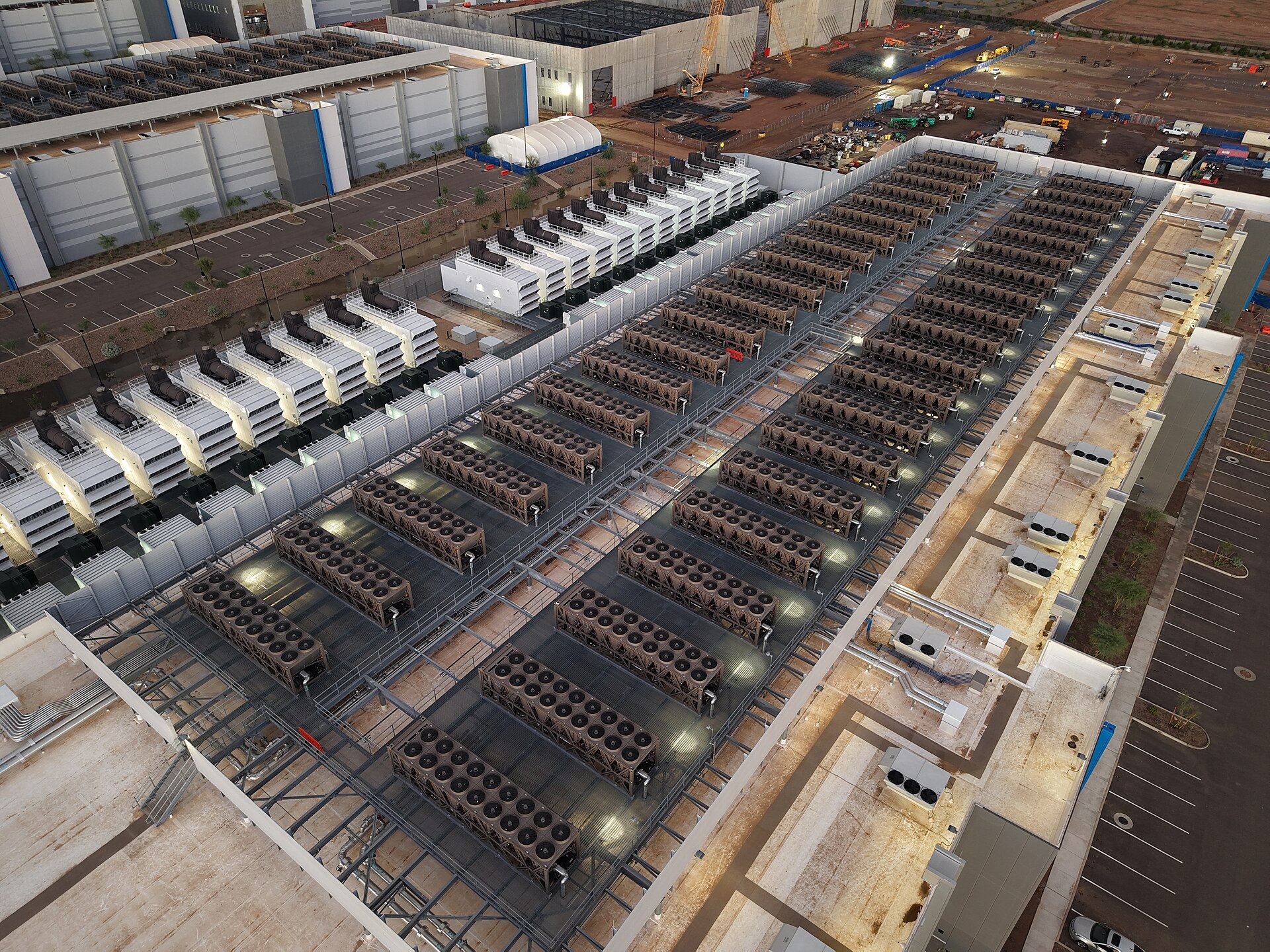
A town council near Frankfurt voted down a 2.5 billion euro campus. A 1.6 GW application in Lower Silesia was withdrawn after the grid operator stayed silent. Hillwood moved its buildings away from the houses in Reguły, and residents south of Warsaw learned about a 70 MW site when the fence went up. After power and permits, the next constraint on data centre land in Germany and Poland is the neighbour, and it is already changing what a site is worth.
From grid queue to village hall
For two years the data centre debate in both countries has been about electricity. We have covered the grid queue and the race for power plant sites. In 2026 a second filter has appeared underneath the connection: local acceptance. It operates through council votes on zoning plans, environmental decisions, petitions and, increasingly, through the courts. It does not show up in any capacity statistic, but it decides which of the megawatts on paper become buildings.
The pattern is the same on both sides of the Oder. A developer secures or reserves capacity, approaches a municipality that needs trade tax, and meets residents who hear about the project from a public notice, a fence or a local newspaper. What follows is a negotiation over distance, height, noise, water and information. Where the developer engages early, the project shrinks and survives. Where it does not, it stalls.
Poland: Reguły, Piaseczno and the 1.6 GW that nobody briefed the council on
The most instructive case is Reguły in the Michałowice municipality west of Warsaw. Hillwood Polska plans a campus of around 130 MW on more than 22 hectares between Aleje Jerozolimskie and the WKD railway line, in four buildings that may be let to different operators. Environmental documentation cited by Globenergia puts annual water demand at 334,000 cubic metres, roughly 915 cubic metres a day, mostly for adiabatic cooling, with electricity consumption of about 1.47 TWh a year and diesel storage of up to 3,600 cubic metres. Residents report that the site edge would be about 30 metres from the nearest homes. Around 1,200 people signed a petition, and the mayor ordered a full environmental impact assessment in 2024 covering day and night noise, generator tests, cumulative effects and a wildlife survey within 500 metres.
In September 2026 Hillwood presented a revised concept: buildings moved towards the main road and away from housing, a denser green buffer, smaller individual buildings, closed-loop cooling with adiabatic operation only on the hottest days, a separate medium-voltage connection financed by the investor, acoustic screens and generator tests limited to the least disruptive hours. The first building to be built is the smallest and the furthest from homes. Each building goes through its own environmental procedure, which residents criticise as salami slicing, while Hillwood says cumulative analyses will follow for later phases. The project is not yet approved, but it is the first large Polish campus whose design has visibly been rewritten by its neighbours.
South of Warsaw, on the boundary between Piaseczno and Józefosław, construction of the Sien data centre began in early August 2026: four buildings of around 4,500 square metres each with a connection of roughly 70 MW, according to TVN24. Residents say they learned of the project when the fence went up and the excavators arrived, that no information meeting was held, and that the neighbouring housing cooperative was not a party to the proceedings. A protest followed in mid-September, a complaint went to the Ombudsman and the case is now in court. The investor has promised acoustic screens and reduced cooling output at night. A second centre a few hundred metres away has no environmental decision yet, and a third project in Bobrowiec holds an environmental decision from July 2025 but cannot apply for a building permit because the local land-use study expired at the end of August and no local plan exists. Józefosław already experiences drops in water pressure; the investor confirmed that the centre’s demand could equal that of a settlement of 3,000 people.
Trzebnica, north of Wrocław, shows the other failure mode. WBS Power, a renewable energy developer, filed an application in January 2026 for a campus with a connection capacity of 1,600 MW across two connections, buildings up to 35 metres, 80 per cent site coverage and a declared noise level of 40 dB(A) at the boundary. On 19 January the council voted to start the planning procedure. Councillor Marcin Raczyński later complained that councillors had received a draft resolution, a map and a short justification, but not the application itself. In September the landowner said the investor had withdrawn from the plot purchase because grid operator Tauron had not confirmed it could supply the power. The plan change remains formally open. In the words of Michał Czepkiewicz of the University of Warsaw, quoted by Interia, Polish planning law simply does not define data centres, and they are not listed in the regulation on projects that may significantly affect the environment. That gap is what makes every project a local improvisation.
Germany: Groß-Gerau says no, Freyenstein and Beuchte organise
Germany produced the clearest precedent of the year on 3 February 2026, when the town council of Groß-Gerau near Frankfurt rejected a 174 MW campus by Vantage Data Centers by 18 votes to 14. The site was 14 hectares of industrial land the company had already bought, the investment was put at 2.5 billion euros, and the town had requested 14 million euros in emergency aid from the state of Hesse four months earlier. The majority of SPD, Greens, FDP and Left cited building height and a fresh-air corridor into the town. Vantage replied that the height could have been reduced and that most waste heat would have stayed in a closed water circuit available for the town’s heating network. A debt-laden municipality in the core market turned down a nine-figure trade tax base because the building was too big. That is the benchmark every developer in the Rhine-Main area now plans against.
In Brandenburg, where 40 per cent of Germany’s planned capacity now sits, the resistance is rural. At Freyenstein, a village of 800 people in Ostprignitz-Ruppin, two linked firms from Frankfurt and Munich presented a 144 hectare project with up to 20 buildings of 27 metres, more than 1 GW of demand and a claimed 25 billion euros of investment. A citizens’ initiative gathered about 1,200 signatures online, the village already lives next to some 50 wind turbines, a biogas plant and solar parks, and the village mayor called the project oversized in its published form. The grid connection is not secured, a binding land-use plan with public participation is still required, and construction would not start before late 2029. In Lower Saxony, the municipality of Schladen-Werla passed the start resolution for a development plan at Beuchte near Wolfenbüttel: around 14 hectares and 200 MW, with capacity reserved according to the developer and first phases targeted for 2030 or 2031. Within days, residents founded the initiative “Gemeinsam für Beuchte – gegen das Rechenzentrum” and announced a petition.
The federal level is pulling in the opposite direction. The national data centre strategy wants to more than double IT capacity from around 2 GW to over 4 GW by 2030, and the Bundestag is expected to vote in November on an amendment to the Energy Efficiency Act that raises the PUE limits and adds exemptions for waste heat use. The new federal data centre register, live since mid-August, shows why acceptance is fragile: of roughly 1,000 reportable facilities, 319 published named data and a further 166 reported anonymously; a third of those reporting already meet future PUE requirements, a third sit above 1.5, and average waste heat reuse is just under 3 per cent. The government’s own interim monitoring lists a standard site-criteria guide for municipalities and a permitting practice check with North Rhine-Westphalia as work in progress. Until those exist, every council improvises its own standard, exactly as in Poland.
What the neighbour costs, and what the neighbour is worth
The economic effect is not a veto on the sector. Poland’s installed capacity stood at around 250 MW in 2025 and is forecast to exceed 550 MW by 2031; projects such as the 500 MW campus at Bełchatów or the 3.2 GW Baltic Data Center Campus announced for Choczewo are being planned next to substations and far from housing. The effect is a repricing within the pipeline. A site with a confirmed connection but 30 metres from a residential street now carries a design penalty: fewer megawatts per hectare, a wider buffer, lower buildings, closed-loop cooling, night-time noise limits, and a timeline that includes a full assessment and probably a court case. A site with the same connection next to a motorway, a substation or a former industrial plant does not. The difference is measured in years, and in Germany it can be measured in a council vote.
The second effect is on information. In all five cases the trigger for resistance was not the data centre itself but how residents learned of it: from a public bulletin, a fence, a newspaper investigation, or a resolution without the application attached. Developers who published their IT and connection capacity, water source, generator testing schedule and night noise model early, as Hillwood eventually did, kept their projects alive. Those who relied on the formal minimum lost control of the narrative to a petition.
What this means for investors
- Distance to housing is now a pricing parameter. Reguły at 30 metres and Groß-Gerau in the middle of town show the cost of proximity. Land next to a substation, a motorway junction or a former plant site with no houses within a few hundred metres deserves a premium that was not in last year’s valuations.
- Price the design concessions in from day one. Assume lower buildings, a green buffer, closed-loop or hybrid cooling, acoustic screens and limited generator testing. A business plan that only works at 80 per cent coverage and 35 metres, as in Trzebnica, is a plan that depends on nobody objecting.
- Treat the zoning procedure as a political process, not a formality. Groß-Gerau rejected a fully financed project on an industrial site. Due diligence should include the council majority, the municipal budget and the local election calendar, not just the land-use plan.
- In Poland, the planning gap cuts both ways. No statutory definition of a data centre means fast entry where the municipality is willing, as in Bełchatów, and a legal vacuum where it is not, as in Bobrowiec, where an environmental decision exists but no plan to build under. Check the study, the plan and the water connection conditions, not only the environmental decision.
- Transparency is cheaper than litigation. Publishing capacity, water and noise data before the first public notice costs a few weeks. The Piaseczno route of fence first, meeting later now runs through the Ombudsman and the courts.
This intersection of real estate, engineering and local politics is exactly where Prime East operates through its dedicated division PE Property Solutions: site and grid connection assessment, acceptance and permitting risk analysis, technical due diligence, structuring of operator and lease models, and transaction support across Germany and Poland.
Conclusion
Germany and Poland are discovering that a megawatt with a neighbour is worth less than a megawatt without one. Groß-Gerau, Freyenstein and Beuchte on one side, Reguły, Piaseczno and Trzebnica on the other, tell the same story: the grid operator decides whether a data centre can be built, the municipality and its residents decide whether it will be. For investors, the land register and the connection queue are no longer enough. The third document to read is the minutes of the council meeting.
Talk to us
Are you evaluating a data centre site in Germany or Poland, or do you hold land with grid capacity near a municipality that has yet to form a view? Prime East assesses sites, connection status, planning and acceptance risk, and brings investors, municipalities and landowners together. Contact our team for a confidential discussion of your investment or project enquiry.
Disclaimer: This article is for general information only and does not constitute investment, legal or tax advice. All figures are based on publicly available sources.
Sources
- Omnichannel News: Hillwood prezentuje zmodyfikowaną koncepcję kampusu data center pod Warszawą (15 September 2026)
- Inżynier Budownictwa: Centrum danych odsuną od zabudowań. Protestowali mieszkańcy (18 September 2026)
- Globenergia: Centra danych wkraczają do Polski: mieszkańcy protestują i apelują o wstrzymanie inwestycji (4 September 2026)
- Money.pl: W ich sąsiedztwie zbudują centrum danych. Zorganizowali protest (17 September 2026)
- Interia Biznes: W Polsce są plany na budowę kolejnych centrów danych. Ale brakuje przepisów, które to uregulują (2026)
- Radio DTR: Trzebnica, 1,6 GW i centrum danych (30 September 2026)
- BeBeez / DCD: Uncertainty over data center development in Trzebnica, Poland (9 October 2026)
- Brussels Signal: German town turns down €2.5 billion data centre project by US investor (11 February 2026)
- Nordkurier: In Ostdeutschland könnte Europas größtes Rechenzentrum entstehen: Doch die Anwohner wehren sich (27 April 2026)
- regionalHeute.de: Großrechenzentrum bei Beuchte: Bürgerinitiative wehrt sich (8 October 2026)
- netzpolitik.org: KI-Boom: Wie die Bundesregierung die Regulierung von Rechenzentren aushöhlt (23 October 2026)
- BMDS: Zwischenmonitoring Rechenzentrumsstrategie (status September 2026)
- PropertyNews.pl: Centra danych wysuszą miasta. Protestujący nie widzą jednak wszystkiego (16 July 2026)